

On what rose water was always meant to be
In today’s world, it is important to be mindful of what we use on our skin and consume in our daily lives. One simple habit I follow is to always read product labels before buying anything, whether it is food or skincare. This small step creates awareness about what we are actually bringing into our lives.
Being a 90’s kid, growing up, many of us were exposed to advertisements for rose water brands that shaped our early understanding of purity and trust. Like most children, I too remember insisting on specific branded products, believing them to be superior, even over what was traditionally made at home and distilled right in front of our eyes.
Such is the power of advertising. It builds belief long before we learn to question it.
As I grew older and began to understand ingredients and formulations more closely, I developed the habit of reading product labels. What began as curiosity gradually became awareness. To my surprise, I realised that some widely available products marketed as “premium rose water” were not always derived from traditional rose distillation. In several cases, ingredient lists reveal formulations built on a base of water, synthetic aromatic compounds or fragrance designed to recreate the scent of rose, small quantities of rooh gulab/rose oil (as claimed), along with stabilizing agents such as propylene glycol and preservatives like methyl paraben, propyl paraben, or bronopol to ensure shelf life and stability.
None of this is about good or bad ingredients. It is about clarity.
Each ingredient serves a function. Water forms the base. Fragrance recreates aroma. Humectants help retain moisture. Preservatives ensure stability and prevent microbial growth over time. But together, they represent something more specific. This is not rose water in its traditional sense. It is a cosmetic formulation designed to recreate the sensory experience of rose while ensuring consistency, longevity, and commercial stability.
This distinction is important, not to judge the formulation, but to understand it.
And this understanding was not limited to rose water used on the skin. It became even more evident when I looked at something we all grew up with, rose/rooh sharbat. Almost every household had a bottle during summers. That bright red “rose/rooh” sharbat, served in a glass full of ice, was hard to resist. Even today, it brings back the same nostalgia. But when you read the label, the story shifts:
Sugar syrup 87.8%, additives, preservatives, acidity regulator, and colour.
87.8% sugar!!
And yet, interestingly, I never felt the same pull towards real rose sharbat, the one made from actual rose distillate. It isn’t bright red. In fact, it is colourless! Now imagine children drinking a glass full of sugar and additives, when what they truly need during their growing years is nourishment.
Try this in its simplest form, if you have pure rose water, add a few drops to your homemade lassi.
The aroma is subtle, almost gentle… but it stays with you. It doesn’t announce itself; it simply transforms the experience.
The same simplicity applies to rose sharbat as well. At its core, it doesn’t require anything more than rose, sugar, ice, and water.
It was a quiet but important shift in perspective..realising how perception and composition are not always the same.
It also changed the way I look at products today. Not with judgment, but with awareness.
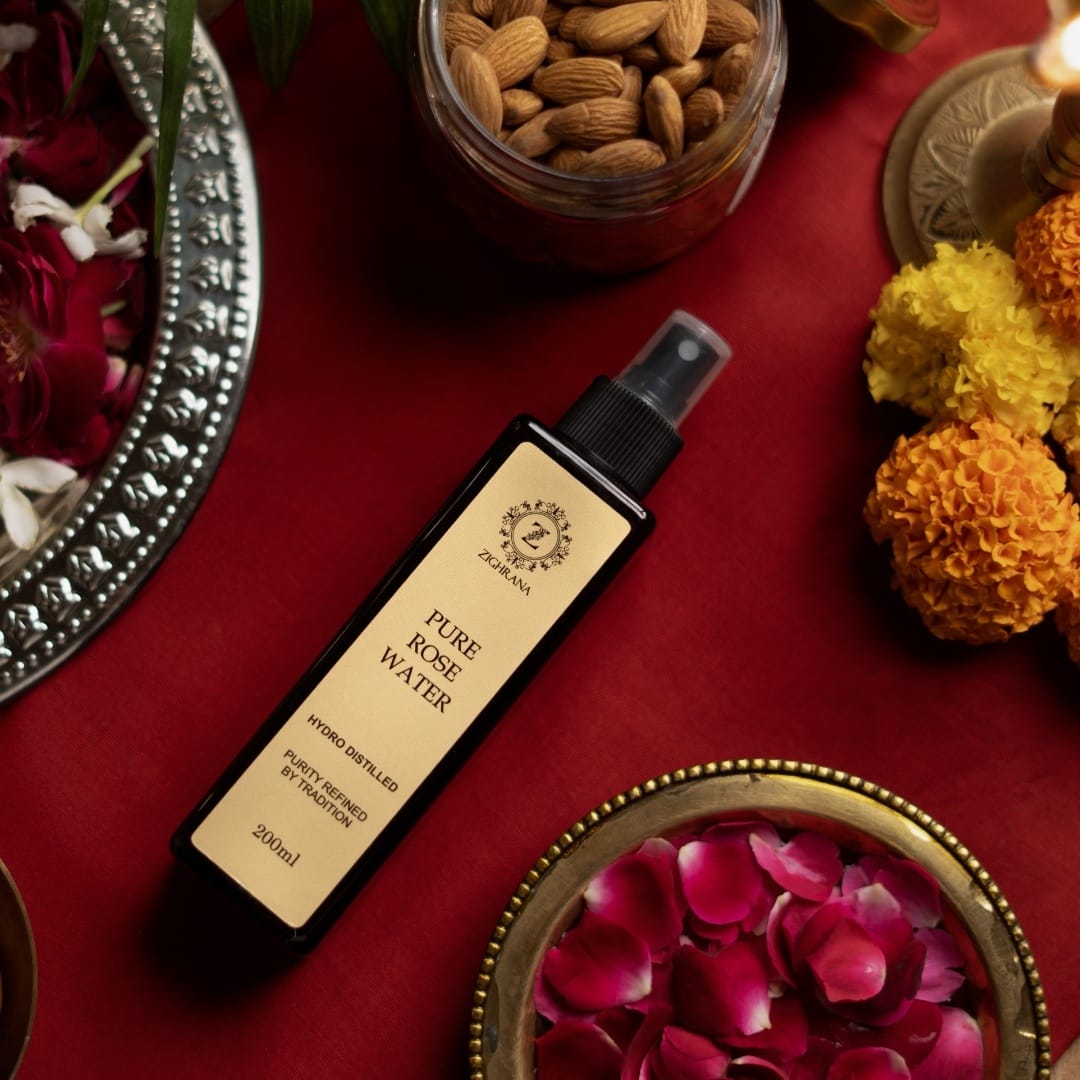
Pure rose water comes only from distilled roses. Nothing more, nothing less.
At Zighrana, we believe rose water should remain what it was always meant to be, simple and pure.
Our rose water is created using the ancient deg bhapka technique, a traditional method of hydro distillation in copper vessels.
It is a slow, time-honoured process where roses are distilled in their most authentic form, without unnecessary additions or reinterpretation.
It is not about creating something new. It is about preserving something old, exactly as it is.
We do not believe in over-complicating nature.
There are no exaggerated claims, no unnecessary noise, only a commitment to authenticity.
Pure rose. Nothing else.
At Zighrana, luxury is not addition, it is preservation. The preservation of craft, tradition, and purity that has existed for generations.
— Swapnil
Founder, Zighrana
Great article, very helpful!
Excellent explanation, thanks!
This guide explained everything clearly.